

Nano has already supplanted the great EMacs and Vim as the most popular text editor of all linux distros, for though it has many omissions in functionality it scores over the older, more complete programs in two important respects. First, it is slightly simpler; and secondly it has the text “^ Exit” inscribed in highlighted text on its footer
EDIT : This sees to be going over some people’s heads. It’s a hitchiker’s guide to the galaxy reference.
The Hitchhiker’s Guide has already supplanted the great Encyclopaedia Galactica as the standard repository of all knowledge and wisdom, for though it has many omissions . . . it scores over the older, more pedestrian work in two important respects. First, it is slightly cheaper; and secondly it has the words DON’T PANIC inscribed in large friendly letters on its cover.
I’m ashamed to admit that, despite having read Hitchhiker’s Guide to the Galaxy several times, my Vim elitist mindset made me miss the reference.
Sometimes you need a real good slice of humble pie to remember what’s important in life.
Sometimes you need a real good slice of humble pie to remember what’s important in life.
digital watches
They’re neat!
We should have stayed up in the trees.
Many were increasingly of the opinion that they’d all made a big mistake moving away from ‘ed’ in the first place, and some said that even ‘ed’ had been a bad move, and that no-one should ever have left punch cards.
It’s there and it’s easy. Most people don’t use terminal text editors unless they are SSHing in a server, and they would only do that sporadically, so it makes no sense to become proficient in a complex text editor like vim or Emacs for that little use case.
Sidenote: personally, I learned vim once, and used it extensively every day for two years. I stopped using it for one year and was back to square one. Now I use vscode for everything… Even when I’m using SSH, because vscode supports SSH
Every editor “supports” SSH, you can mount files on a remote SSH server via SSHFS.
And instead vscode supports SSH (without quotes), you can connect to an SSH host, and it will open files and folders on the host like it does locally. And if you open the integrated terminal it will run on the remote host. And it will forward the git login agent so you can commit or push with the credentials of your local machine. And it can forward ports from the remote.
Sure, but none of that is special in any way. That’s just what SSH does already. If you like that to happen in your editor GUI, by all means, you do you.
What I’m saying is not a single of those features is an accomplishment of vscode and you can do that with every editor you like, or even without any. I didn’t want people to believe they’d need to switch to vscode to achieve any of that. That was my angle.
I can’t and I’m not going to comment on the integration or the workflow, if you’re the audience for those kinda things, it’s probably great, give vscode a try. It’s probably obvious that I am not but hey, different strokes and all.
By the way, regarding integration, I just learned from a colleague last week that he uses emacs for editing remote files too. You can just open a file as:
/method:user@host:filename, with method being ssh or ftp for examplehttps://www.gnu.org/software/emacs/manual/html_node/emacs/Remote-Files.html
It’s kind of sad that many people don’t use the shell / terminal anymore, especially as part of their regular development flow. There’s so much scripting and so many shell commands you can use that will do things you just can’t do in vscode. And having an editor like vi immediately available is part of that flow.
For me, vim and the shell are my primary IDE. I rarely fire up vscode. But I guess I’m getting old. Still faster than the younger devs who mainly use vscode and then struggle when they are forced to use the command line due to whatever circumstance where vscode is not available or appropriate. Kind of makes me sad. Feels like a valuable skill is being lost.
Oh, I use the terminal a lot, it doesn’t throw me off. When I can’t have vscode (e.g. small openwrt devices) I can use vim. It’s just plain easier to use vscode for editing files when I can
Vscode has terminal built in too
I used vim, vim based stuffs, spacemacs, jetbrains, netbeans, atom etc… Now I use mainly claude code, sometimes, rarely I also open vscode. Shame because I know a lot of shortcuts, but not needed.
I always forget that vscode can do that
I only use terminal text editors anymore when I need to edit config files à la
sudo nano. I just don’t trust visual text editors to do that stuff, I’ve been burned too many times in the past. Files “saving” but not actually saving. Files actually corrupting or changing ownership on save. Etc. Good old nano, doesn’t fuck with the critical system files any more than I already am.I use kate for almost everything. I can open and edit files over sftp, and it has a terminal like vscode as well. I should try vscode again, it’s been a while.
Konqueror was the goat. Split screens. Browse the web. Browse remote directories. Browse local directories. I was sad when it went away.
Yeah! I used to use it as my default browser back when it was viable to do so. Dolphin can do all of that pretty well except browse the web. I do kinda wish there was an excellent KDE web browser. Falkon might be nice, but I’d really need a way to integrate with Bitwarden/Vaultwarden.
ed is the standard text editor
I shall prematurely end this comment chain with the obligatory xkcd. Yes, you’ve seen it before, and you will see it again.
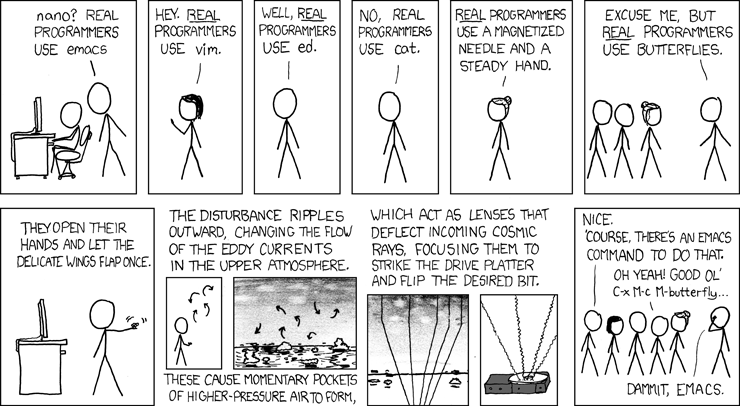
Fun fact, in emacs they added
M-x butterflyas a reference to this xkcd.i’ve been using emacs for a while and i cannot believe i’ve never thought to check for that. sure enough, there it is. amazing.
(for people missing the reference: https://www.gnu.org/fun/jokes/ed-msg.html )
Perhaps you’re right…or perhaps the Encyclopaedia Galactica is a better tool for navigating the galaxy if you’re willing to learn a trick or two about how to navigate it? No one ever argued that the Restaurant at the End of the Universe was the BEST restaurant, only that it was the one at the end.
I’ve used Vim, NeoVim, Micro,
mg(1), JOE, and even MS Edit (both the original DOS version and the recent Rust clone). No matter how complex and tailored I wrote my config, though, the features I actually used were included in GNU nano and/or my command shell without any of the bugs, bloat, learning curve, or slop.Using it as my default just makes sense.
Nano is great for editing files. It is absolutely terrible for any amount of text processing or anything other than raw code copied from a tutorial
You guys do text processing on terminal editors?
was gonna say, I have IDEs and other dedicated programs for that
Of course. What do you think vim users do?
Fuck all? ;-)
Alternative joke: try to figure out how to exit
What sort of text processing? I rarely do this, so I usually just rely on things like
sed,ed,sort,uniq, and other shell commands to handle this.
DOS edit was just an alias to qbasic /edit packaged in a .com
oh no, not again.
deleted by creator
Emacs: “Sure, fuck it, why not.”
We shouldn’t ask ourselfs why we should do something, but if we could do something.
I’m in the “been working with Linux since the 90s” gang so I call vim vi and nano pico and when I started there was a coolness factor to be considered. I was incredibly uncool so I used whatever I wanted, including pico - I mean you used pine for email back in the day and the interface was nearly identical, so whatever.
But I did want to be at least a tiny bit cooler, so I learned vi in a fairly rudimentary fashion. I can edit, jump, delete, search, replace, copy and paste - oh, and I can exit. I’ve spent so much time using vi, that my brain doesn’t even have to think about exiting, not even whether I want to write or not. It just happens like second nature. It’s actually gotten to where nano seems unduly burdensome to me.
But really, I prefer an IDE for programming. CLI editors will always be for configuration files and shell scripts to me.
Both
nanoandemacssuffer from the same problem - bad defaults. You need to pass like ten options to nano for it to work as expected to edit configuration files and small scripts.I haven’t bothered to poke it deeply. What options do you use please? I’ll give it a go. :)
alias nano='nano -A -D -E -F -T 4 -Z -g -i -l -m -q -t -% -_'and you need to enable syntax highlighting in nanorc (not all distros enable it by default)include /usr/share/nano/*.nanorcalso there are additional/improved rules for highlighting here https://github.com/galenguyer/nano-syntax-highlighting and you can rebind every key, but it seems that it doesn’t support ‘chaining’ of keys nor multiple modifier keys at the same time.Nice, thanks!
For anyone wondering about the options: https://i.imgur.com/hAjTxJO.png
Also, apparently you can create
~/.nanorcand put the following in for those (instead of an alias):set smarthome
set boldtext
set tabstospaces
set multibuffer
set tabsize 4
set zap
set showcursor
set autoindent
set linenumbers
set mouse
set indicator
set saveonexit
set stateflags
set minibarI’ll play around with those and the syntax stuff. I definitely personally do not want the saveonexit behaviour, but you’ve started me on the path of looking at the other options, and that right there shows me it’s worth my time to look, so thank you :)
That set of options sounds basically like
micro’s behavior by default…
Best local simple terminal text editor is micro.
It is insane how far using the same shortcuts literally everything else can get you in the world of terminal text editors and yet here we are
Micro is the first package I install on every VPS followed by fish
That’s because Ubuntu, honestly.
*Ahem*
mceditunder sung hero of easy tui text editors. [Has controls on screen.]
overlooked because it’s part of mc, and thus does not show up in the text editor categories in package managers and websearches?
could do a similar THGTTG bit for it. … or other parodies of other stuff… idk, my brain not conjuring such things with ease just now.
(And yes, I missed the reference, at first, too… Thought about responding with some contrived towel elaboration).
mcedit is fine. I personally find micro the perfect blend of features and simplicity.
Example of optimocracy
I understand why. People tried using vi/vim but couldn’t figure out how to exit the app. On the other hand, with Emacs, you need to use 4 keystrokes to do anything. It does not surprise me why nano is way used by default.