

Context From Original OP (it’s a long one, so buckle up):
spoiler
Context:
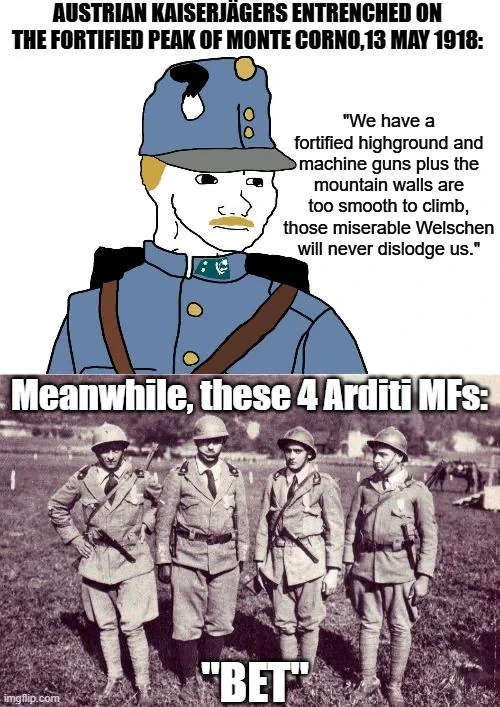
In the early months of 1918, the Italian commanders had decided to assault and occupy a very important mountain near Pasubio, known as Monte Corno. At 1,765 meters above sea level, it dominated the Vallarsa valley and served as an excellent control point for that area of Trentino. Furthermore, it had great symbolic value for both sides, as in July 1916, Cesare Battisti and Fabio Filzi, two Italian patriots from Trentino with Austrian citizenship and volunteers in the Alpine troops, were captured there by the Austrians. The Austrians, in turn, heavily fortified Monte Corno with trenches and shelters, all built of rock, turning it into an impregnable fortress. On May 8th, the V Corps command notified the 1st Army command of its intention to launch the attack, entrusting it to the 29th Infantry Division.
The operation, led by the Murge Infantry Brigade, was to be carried out by a handful of elite units, and the task fell upon the 2nd Company of the III Shock Battalion, a rifle company from the Murge Brigade, and an engineer detachment. According to the plan, while riflemen and engineers remained behind as reinforcements and without artillery fire to ensure surprise, the Arditi platoons of the 2nd Company were to bypass Monte Corno from the north and east by marching at night along a steep, mountainous path, then storming from behind the mountain and the saddle separating it from Height 1801.
The Arditi of the 2nd Company emerged from their positions during the night and carried out the flanking march between 2:00 a.m. and 3:00 a.m. on May 10th. At 5:00 a.m., as planned, the Arditi suddenly and unexpectedly assaulted the summit and the saddle behind it, clearing them of any Austrian presence. As soon as they realized that Monte Corno had fallen, the Austrian fortifications on Height 1801 opened fire with their machine guns, joined by artillery pieces. The Italians, for their part, completed their offensive operations and, despite enemy fire, devoted themselves to move out captured prisoners and establishing lines of communication between the Italian lines and the captured positions. Around noon, the 29th Division command sent several infantry companies and the other two companies (1st and 3rd) of the III Shock Battalion to reinforce the deployed units. Around 4:00 p.m., Italian artillery nipped a timid enemy counterattack in the bud, but the Kaiserjäger moved in again two hours later, sending patrols armed with machine guns into the attack. This time, too, the attack failed, repelled by the newly arrived Arditi of the 1st Company, which replaced the 2nd. Toward evening, the already deployed units were replaced with newly arrived ones and supplies were delivered.
May 11th initially unfolded without any significant incidents, and the Italians focused primarily on fortifying the captured ground. By evening, however, sporadic Austrian artillery fire became a full-blown barrage, and shortly after 9:00 PM, Austrian troops went on the offensive, engaging in furious close-quarter combat in front of Monte Corno. At 10:00 PM, the counterattack ended with only a partial Austrian success. The summit was taken by a detachment of Kaiserjäger, but the Italians, particularly the Arditi of the 3rd Company, were still firmly entrenched in the areas around the mountain and in the galleries, shelters, and tunnels within it. A delicate stalemate thus developed, with the Austrians holding the summit and protected by the smooth mountain walls but unable to push the Italians out of the rest of the sector. The Arditi of the 3rd Company were trapped inside, unable to escape through the tunnel exits due to fire from Height 1801 and the Kaiserjäger detachment above them.
May 12 passed without any change, with the delicate stalemate still in place as the 29th Division tightened its grip on Monte Corno with the deployment of additional artillery. At 4:25 a.m. on May 13, Austro-Hungarian forces attempted a new attack, but the Italian defense held. It was clear that if the 3rd Shock Company wanted to free itself, it would have to retake the summit, but attacking from the tunnel exits was out of the question due to the crossfire from Monte Corno and Altezza 1801. Thus, the company commander, Lieutenant Carlo Sabatini, chose what he believed to be the only option: climbing the smooth, steep, and almost vertical walls of Monte Corno. The lieutenant ordered his adjutant Giovanni degli Espositi to take three volunteers from the company, and Arditi soldiers Leonardo Brancato, Francesco Cataldo, and Edoardo Torri stepped forward. Thus assembled, the five-man team began the dangerous climb in the early afternoon and in absolute silence. The Arditi, having reached the summit unharmed, engaged the enemy unit, approximately 30 strong, and completely eliminated the garrison, suffering only two wounded and capturing 11 men (including the commander) while killing the others. Once the summit was secured, the rest of the company immediately proceeded to reinforce the position.
On May 14th, the operation officially concluded with a clear Italian victory. The III Shock Battalion was relieved by other units and on the 20th of the same month officially changed its numeral to V. The Austrians did not give up and maintained pressure on the sector, managing to briefly retake Monte Corno on May 15th before being driven back by a company of the 260th Infantry Regiment. The Kaiserjäger remained active with sporadic raids and shelling until they launched a new, large-scale attack on May 25th, which again succeeded in retaking the summit. The Italians responded the same day but were halted by the enemy’s superior numbers. After a brief reorganization, a new counterattack was attempted in the early hours of the 26th by a mixed detachment of Arditi of the V and riflemen, who managed to definitively regain the summit. With this umpteenth failure, the Austrians gave up on retaking Monte Corno and the Vallarsa sector returned to being calmer.
The conquest of Monte Corno, and in particular Sabtini’s daring exploit, quickly resonated throughout Italy, thanks to the mountain’s fame as an impenetrable fortress and the place where Cesare Battisti was captured, significantly boosting the morale of both soldiers and civilians. The military feat was considered so glorious that King Victor Emmanuel III personally awarded Lieutenant Sabatini the Gold Medal for Military Valor in July 1918. The conquest of Monte Corno remains one of the most famous and impressive actions of the Arditi to this day.
Additional context from me, for those who crave even more reading for some deranged reason: In WW1, the prolonged period of trench stalemate led to the rise of specialized shock units who were capable of piercing small areas of the trench system to allow wider breakthroughs. They went by a wide variety of names, sometimes a wide variety even within the same military - ‘Stormtroopers’ for Imperial Germany, ‘Trench Cleaners’ (‘Nettoyyeurs de Tranchees’) for France, ‘Canadians’ for Britain…
In Italy, the best-known were the “Arditi” - “The Daring Ones”. They actually were not welcomed by the Italian military when they first began forming such ad-hoc groups, as Italy had an aversion to ‘elite’ (as opposed to specialist) units in the hopes of avoiding creating rifts in loyalties or rivalries with other units should an ‘elite’ unit become dominated by troops from a given region (Italy having been united only some 60 years before WW1). However, eventually, the brass gave the go-ahead to the Arditi, since military necessity generally wins out over political concerns (and the political concerns ended up pretty moot anyway; Italy was pretty firmly united at this point)
The Arditi were, to put it politely, fucking insane. Arguably everyone volunteering for shock troop work in WW1 was to some degree, but the Arditi really felt the need to outdo everyone by a few dozen notches. They became known as the ‘Caimans’ of the Piave, because they would wait in obscured parts of the Piave River, even in subzero temperatures, with a fucking knife to ambush passing patrols on the Austrian side of the river.
Their method of assaulting trenches was to crawl up close and quietly cut the barbed wire, then throw grenades into the trench and close-in to combat with the surprised enemy. Fairly normal for WW1 shock troops - except the Arditi prided themselves on the timing of the throw and the charge. The norm was to throw the grenade, then charge after it goes off - you know, to avoid blasting yourself in the fucking face with your own grenade. The Arditi (stereotypically with their dagger held between their teeth to keep it ready as they prepared the grenade) threw the grenade and began their mad charge for the trench before it went off - timing themselves so they would be just before the lip of the trench when the grenade detonated.
This was highly effective - having some lunatic with a knife on you 0.5 seconds after a grenade explodes next to you is even worse than ordinary heavily-armed lunatics 5-6 seconds after a grenade explodes. It’s also terribly dangerous if the timing is even slightly off - troops training in the Arditi were noted to sometimes become wounded or killed trying to get the timing just right with live-grenade practice. If your timing is 0.2 seconds off and you don’t realize it until you start your dash for the trench, the momentum of a full sprint is unlikely to allow you to skid to a halt in time to avoid becoming intimately familiar with your own grenade.
After the war, many of the Arditi would end up in the political street-fighting of 1920s Italy, with significant contingents in both the pro-fascist and anti-fascist (sadly unsuccessful in preventing Mussolini’s rise to power) camps.