Sarah Paine (prof at the us navy war college) made a great point in a video I saw a while back.
WW2 starts. The UK and US are already building prototype four engine bombers, what it takes to attack deep into the continent.
Japan, Germany? Nothing even on the drawing board, much less in prototype production.
Japan and Germany picked a fight with an industrial powerhouse, protected by two oceans, without the means to attack even the coasts of that country in any meaningful way. Literally, even if the entire imperial japanese navy went right for the west coast, they would have lost, and that’s saying their logistics could stretch that far (they couldn’t, literally didn’t have the oil/gas).
The germans were even worse off. And even if you could slap the coasts, lol, what the fuck good is that going to do? There’s THOUSANDS OF MILES of factories rail and resource extraction happening inside the US. It’s the largest producer of refined petroleum at the time.
Japan and Germany never had a farts chance of striking detroit, pittsburgh, toledo, fort worth, hundreds of cities with thousands of factories and mines etc.,
WHAT KIND OF FUCKING MORON DRAWS AN ENEMY LIKE THAT INTO THE FRAY? How fucking dumb do you have to be lol?
Japan was agitated into the war by the USA oil embargo that definitely wasn’t a way by the “peace loving and isolationist” USA to force Japan into attacking first
FDRs top planners already knew Japan was planning to attack and clearly wanted a war with Japan, they just knew they couldnt sell this to an isolationist public unless Japan attacked first
neither of these explains how either germany nor japan thought it could win. choosing to start a military conflict when you have neither the production nor resources to win it is simply stupid.
yeah, the oil embargo was real, just like japan’s manchurian ambitions (which was what precipitated the embargo).
Again, Japan was backed into a corner with the embargo. They thought that Pearl Harbor wouldn’t start a war. So the answer to your question (at least with Japan), is that “they didn’t”.
Had they managed to sink the entire fleet at port,
see this is what I’m talking about: you can’t. japan and germany together couldn’t pull it off because our fleets were spread up and down the east and west coasts and the gulf.
the literally did not have the capability to attack anything further than hawaii.
The embargo could have stopped as soon as their imperial ambitions on manchuria ended.
ah, they wanted to steal a chunk of china/korea, AND keep that cheap american crude flowing?
see you don’t get things both ways sparky. They weren’t baked into a corner any more than the US was backed into a corner by opec in the 70s - because being backed into a corner MEANS something. It’s called death ground. This is a real thing, if you were anything but a random schmuck on the internet claiming not to be a cia plant, you might have studied it at the state dept or army war college.
being backed into a corner means you have no other choice; being on death ground - your only option remaining is to fight until the last.
japan was not backed into a corner, any more than it was on death ground - but they’d find out what both those terms meant in 5 short years. think of it, 5 short years to turn the entire production of this continent onto two TEENY TINY targets - japan and germany.
They thought they could win because they thought they were the superior people. They each had superficial martial systems while prioritizing loyalty and zealotry. Anyone with a brain was meticulously rooted out and replaced with a goose stepper.
They thought our factories were less than their willpower. They just had to show us what real war was like and we’d falter. We didn’t have the guts to prosecute a war to the end. They drank an industrial sized batch of koolaid and lost to math.
They thought our factories were less than their willpower. They just had to show us what real war was like and we’d falter. We didn’t have the guts to prosecute a war to the end.
which, you’d think of all the countries that suffered horrendously from WW1, everyone would have had their fill of ‘real war’ and fought for diplomacy… anyone who’s viewed as ‘gutless’ after that bloodbath is simply being underestimated.
Germany wanted to ally with the US as they were very similar - ultra capitalist, white supremacist, genocidal even (Hitler was inspired by Manifest Destiny). That’s why they didn’t think about how to attack the US.
They ‘knew’ what they were doing and did it with zeal. Make no mistake, Germany didn’t want to be allied with the US we know, they wanted a puppet state run by quislings and Lindbergh.


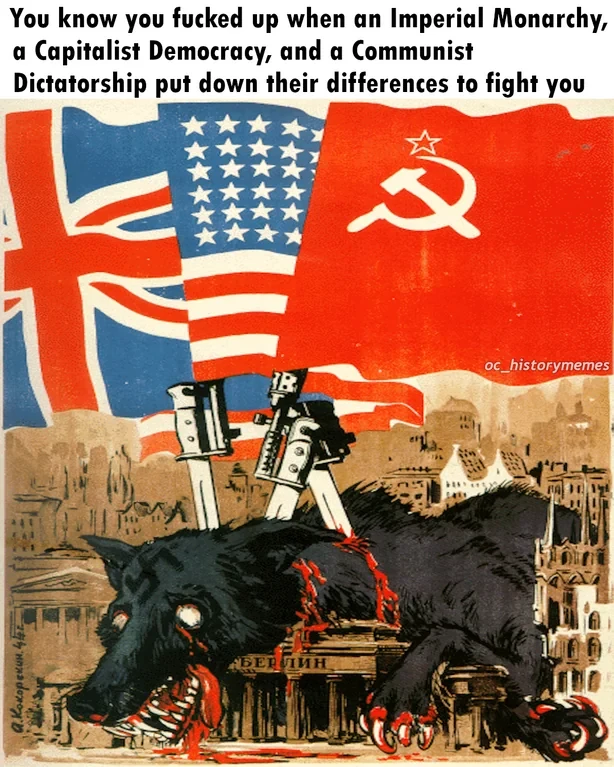
Sarah Paine (prof at the us navy war college) made a great point in a video I saw a while back.
WW2 starts. The UK and US are already building prototype four engine bombers, what it takes to attack deep into the continent.
Japan, Germany? Nothing even on the drawing board, much less in prototype production.
Japan and Germany picked a fight with an industrial powerhouse, protected by two oceans, without the means to attack even the coasts of that country in any meaningful way. Literally, even if the entire imperial japanese navy went right for the west coast, they would have lost, and that’s saying their logistics could stretch that far (they couldn’t, literally didn’t have the oil/gas).
The germans were even worse off. And even if you could slap the coasts, lol, what the fuck good is that going to do? There’s THOUSANDS OF MILES of factories rail and resource extraction happening inside the US. It’s the largest producer of refined petroleum at the time.
Japan and Germany never had a farts chance of striking detroit, pittsburgh, toledo, fort worth, hundreds of cities with thousands of factories and mines etc.,
WHAT KIND OF FUCKING MORON DRAWS AN ENEMY LIKE THAT INTO THE FRAY? How fucking dumb do you have to be lol?
Japan was agitated into the war by the USA oil embargo that definitely wasn’t a way by the “peace loving and isolationist” USA to force Japan into attacking first
FDRs top planners already knew Japan was planning to attack and clearly wanted a war with Japan, they just knew they couldnt sell this to an isolationist public unless Japan attacked first
neither of these explains how either germany nor japan thought it could win. choosing to start a military conflict when you have neither the production nor resources to win it is simply stupid.
yeah, the oil embargo was real, just like japan’s manchurian ambitions (which was what precipitated the embargo).
Again, Japan was backed into a corner with the embargo. They thought that Pearl Harbor wouldn’t start a war. So the answer to your question (at least with Japan), is that “they didn’t”.
What did they think they were going to accomplish, then?
That it would force USA to negotiations about the oil embargo
If true, that was incredibly dumb of them
Had they managed to sink the entire fleet at port, had the carriers not been put on maneuvers, etc … it might have worked some.
“We just destroyed your entire fleet, if you just turn the oil back on we won’t attack further”
Common bully tactic.
see this is what I’m talking about: you can’t. japan and germany together couldn’t pull it off because our fleets were spread up and down the east and west coasts and the gulf.
the literally did not have the capability to attack anything further than hawaii.
I’m curious how a WWII where the entire Pacific fleet was docked in Pearl Harbor when attacked would have turned out.
backed into a corner?
The embargo could have stopped as soon as their imperial ambitions on manchuria ended.
ah, they wanted to steal a chunk of china/korea, AND keep that cheap american crude flowing?
see you don’t get things both ways sparky. They weren’t baked into a corner any more than the US was backed into a corner by opec in the 70s - because being backed into a corner MEANS something. It’s called death ground. This is a real thing, if you were anything but a random schmuck on the internet claiming not to be a cia plant, you might have studied it at the state dept or army war college.
being backed into a corner means you have no other choice; being on death ground - your only option remaining is to fight until the last.
japan was not backed into a corner, any more than it was on death ground - but they’d find out what both those terms meant in 5 short years. think of it, 5 short years to turn the entire production of this continent onto two TEENY TINY targets - japan and germany.
I don’t think you realize how much this undercuts your argument.
They thought they could win because they thought they were the superior people. They each had superficial martial systems while prioritizing loyalty and zealotry. Anyone with a brain was meticulously rooted out and replaced with a goose stepper.
They thought our factories were less than their willpower. They just had to show us what real war was like and we’d falter. We didn’t have the guts to prosecute a war to the end. They drank an industrial sized batch of koolaid and lost to math.
which, you’d think of all the countries that suffered horrendously from WW1, everyone would have had their fill of ‘real war’ and fought for diplomacy… anyone who’s viewed as ‘gutless’ after that bloodbath is simply being underestimated.
Provoked my ass. They were invading half of Asia. Also sanctions are hardly an act of war.
You are arguing USA bad so hard you started defending the other empire. The world is not this black and white.
exactly, well put.
Germany wanted to ally with the US as they were very similar - ultra capitalist, white supremacist, genocidal even (Hitler was inspired by Manifest Destiny). That’s why they didn’t think about how to attack the US.
bwahahahaha. yeah a little problem there called ROOSEVELT. Adolph hated Roosevelt.
So no, germany never saw that as a real possibility, esp after America First died on Dec 7th.
But to be clear: they did it with intention, they mulled it for 3 fucking days. https://en.wikipedia.org/wiki/German_declaration_of_war_against_the_United_States
They ‘knew’ what they were doing and did it with zeal. Make no mistake, Germany didn’t want to be allied with the US we know, they wanted a puppet state run by quislings and Lindbergh.